
⭕ Cases of Scabies Recorded Among Palestinian Female Political Prisoners in Israeli Occupation’s Damon Prison
August 17, 2026
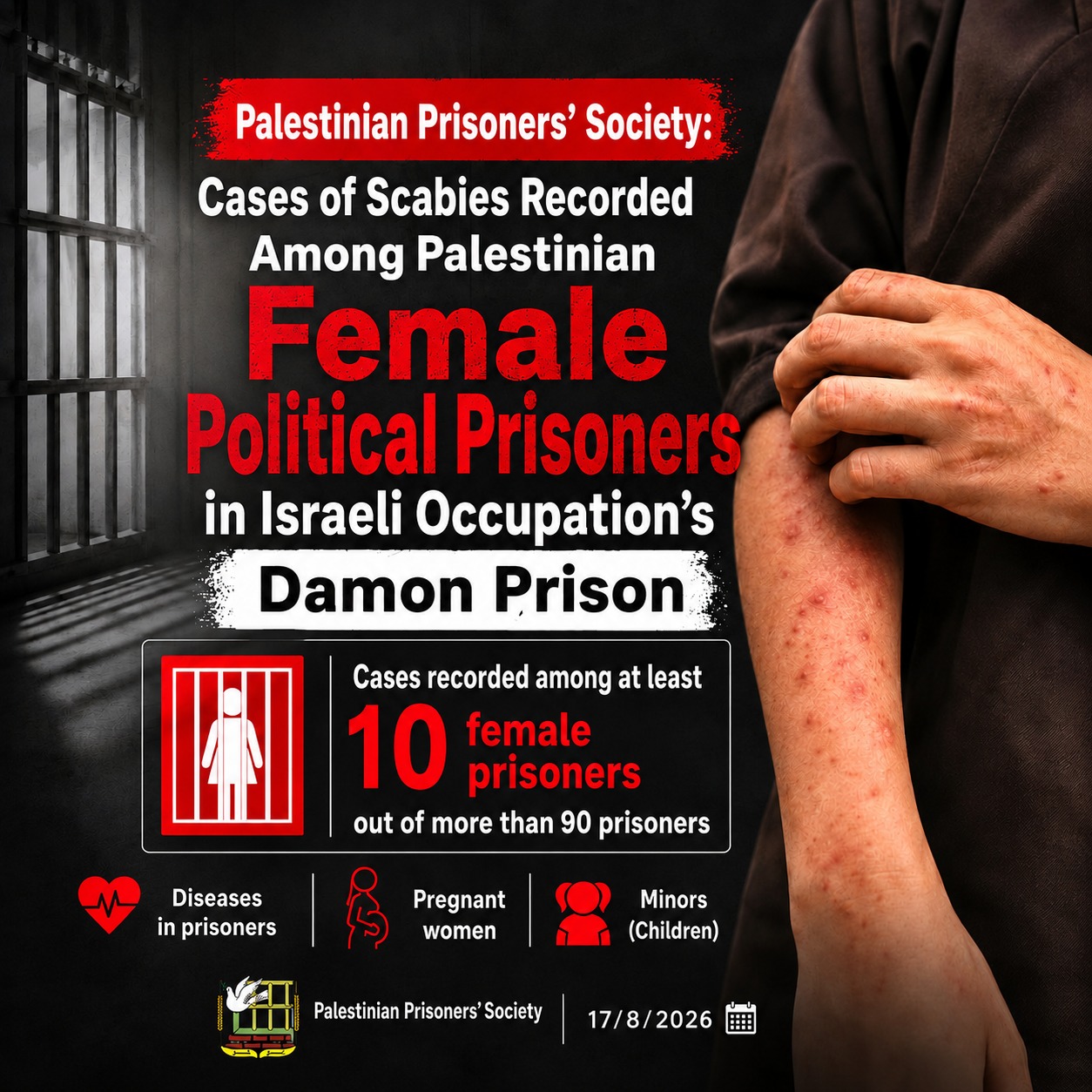
⭕ Cases of Scabies Recorded Among Palestinian Female Political Prisoners in Israeli Occupation’s Damon Prison
Palestinian Prisoner’s Society
August 17, 2026
— Ramallah, occupied Palestine: The Palestinian Prisoner’s Society (PPS) said, based on recent visits by human rights organizations, including the PPS, that cases of scabies have been recorded among women prisoners in the Israeli occupation’s Damon Prison. At least ten women prisoners have been confirmed to have the disease, out of more than 90 female Palestinian political prisoners being held by the Israeli occupation in the prison. Among the 90 prisoners are pregnant women, girls, and women suffering from chronic health conditions.
The PPS explained that the outbreak of scabies among female prisoners at this stage is directly linked to the harsh health and humanitarian conditions imposed by the prison administration, foremost among them high humidity, a shortage of cleaning supplies, overcrowding in rooms and cells, inadequate ventilation, and a severe shortage of clothing. These are the same conditions that have contributed to the widespread spread of the disease among male prisoners since May 2024.
The PPS stressed that the continued spread of the disease, despite it having been documented for more than two years, reflects the absence of any serious effort by the Israeli prison system to address the causes behind its spread. Despite efforts by specialized organizations, including Physicians for Human Rights, and the filing of several petitions demanding treatment for infected prisoners and action to address the conditions causing the disease, the Israeli occupation’s response has remained limited and has neither stopped its spread nor provided prisoners with genuine protection.
The PPS noted that scabies is no longer merely a temporary skin disease in Israeli occupation prisons. In the context of denial of treatment and the continuation of the conditions that cause it, it has become a genuine threat to prisoners’ lives. In numerous cases, it has contributed to the deterioration of their health, and in some cases led to serious complications that resulted in the martyrdom of prisoners.
In this context, the PPS highlighted the case of the child Mohammad Hamid, whose infection with scabies led to a bacterial infection that caused damage to his vital organs and, subsequently, damage to his nervous system. This ultimately resulted in the amputation of one of his legs. The case is cited as an example documenting the serious consequences the disease can cause in the absence of treatment and necessary medical care.
The PPS stated that a large number of prisoners have contracted the disease and partially recovered from it, only to become infected again because the same conditions continue inside the prisons. Others have been suffering from the disease for months, with some infections lasting more than five consecutive months, without receiving effective treatment or serious medical intervention.
It added that infected prisoners suffer from boils, skin ulcers, and severe inflammation as the disease worsens in the absence of treatment, as well as sleep deprivation caused by intense itching and persistent pain. In some cases, these symptoms have limited their ability to move normally, while their psychological suffering has intensified as a result of prolonged pain and illness and the physical and psychological exhaustion they have endured for many months.
The PPS affirmed that the prison administration continues to impose conditions that create an ideal environment for the disease to spread, including denying prisoners personal hygiene supplies, severe overcrowding in rooms, lack of ventilation, denial of exposure to sunlight, and a severe shortage of clothing. The shortage often forces prisoners to wash their clothes and wear them again while they are still wet, under conditions that undermine their human dignity and worsen their health.
The PPS emphasized that the recording of new cases among women prisoners in Damon Prison confirms that the danger posed by scabies remains present and is expanding. It said the situation cannot be treated as merely a health crisis inside the prisons while the conditions that cause and perpetuate the disease continue.
The PPS considers the continuation of these conditions, together with the denial of treatment and healthcare, to be part of a broader system of policies involving torture and systematic medical neglect against prisoners. It said diseases and epidemics, alongside the denial of medical care, are being used as tools that exhaust prisoners, put their lives at risk, and leave deep physical and psychological effects on them.
The PPS renewed its call on the World Health Organization and all international human rights and humanitarian organizations to take urgent and immediate action to stop these systematic medical abuses against prisoners, and to pressure the Israeli occupation authorities to end the policies and conditions that have turned prisons into fertile environments for diseases and epidemics. It called for ensuring the provision of necessary treatment and healthcare to all prisoners, particularly those suffering from infectious and serious diseases.
The PPS also called for a serious international investigation into the conditions surrounding the spread of diseases inside the prisons and for those responsible for maintaining these policies to be held accountable. It stressed that international silence in the face of these crimes cannot continue, and that protecting prisoners and ensuring their right to treatment and healthcare is a legal and humanitarian responsibility that cannot be delayed any further.