
Withholding the Dead: Israeli Occupation’s Policy of Punishing Palestinians Beyond Life
27/8/2025
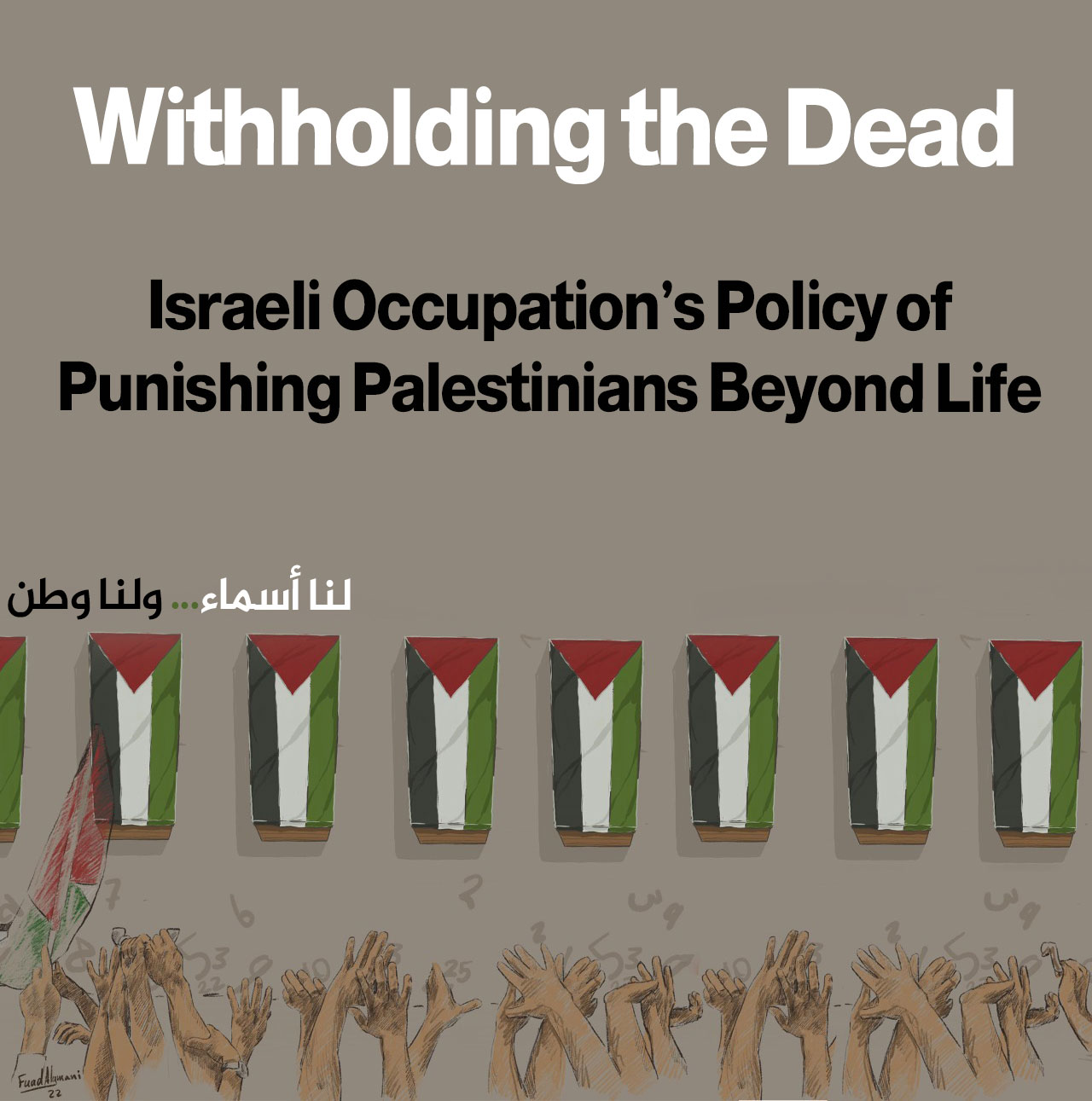
Withholding the Dead: Israeli Occupation’s Policy of Punishing Palestinians Beyond Life
Overview
For more than five decades, the Israeli occupation has enforced a policy of withholding the bodies of Palestinians killed by its forces. Families are denied the most basic right to bury their loved ones in dignity, while corpses are held in morgues or buried secretly in what are known as the “cemeteries of numbers.” This practice is not incidental but has been gradually institutionalized and embedded in Israeli law. In reality, it extends colonial control beyond life into death, stripping Palestinians of dignity, memory, and closure.
A Policy of Control Over Death
The withholding of bodies is part of what scholars describe as necropolitics: the use of death as a means of power and domination. By denying Palestinians the right to grieve openly, the Israeli occupation controls even the most intimate expressions of loss. Families are forced to endlessly wait for the return of their loved ones’ remains, and if they are released, funerals are restricted to night hours, with only a few relatives allowed to attend under police supervision. In this way, the occupation asserts sovereignty not only over Palestinian life, but also over mourning and memory.
Legalization Through Israeli Law
What began as an ad hoc military practice has gradually been entrenched in Israel’s legal system. Since 1967, hundreds of Palestinians have been buried in secret “cemeteries of numbers.” Although a 2004 directive briefly limited the policy, it was revived in 2015 under the pretext of British Mandate Regulation 133(3). In 2017, the Supreme Court ruled that withholding bodies lacked legal basis but suspended its decision, giving the government time to legislate. The Knesset responded with a 2018 amendment to the so-called “Anti-Terror Law”, explicitly authorizing the practice. In 2019, the Court reversed itself, permitting withholding for “bargaining” in certain cases, and in 2020 the policy was expanded to cover all Palestinians accused of attacks. These developments illustrate how unlawful practice has been codified through a shifting blend of regulations, judicial rulings, and new legislation.
Human Toll on Families
The consequences of this policy are devastating. Families endure suspended grief, unable to begin the mourning process without the body of their loved one. Corpses withheld in morgues are often returned as frozen, disfigured remains, leaving parents traumatized and robbed of the possibility of a final farewell. In many cases, the Israeli occupation conditions the release of bodies on heavy financial deposits, bans on public mourning, and burials outside of family cemeteries. These measures punish not only the dead but also the living, creating an atmosphere of fear and humiliation that extends beyond the grave.
Numbers and Scope
According to the documentation of the National Campaign for the Retrieval of Martyrs’ Bodies, 726 bodies have been documented as being withheld in Israeli morgues and the cemeteries of numbers. Of these, 256 are buried in the “cemeteries of numbers”, while 469 have been withheld since 2015, reflecting the sharp intensification of the practice in recent years. The victims include 67 children, 85 prisoners, and at least 10 women. Beyond these figures, credible reports suggest that Israel has at times withheld thousands of bodies, including in Gaza during large-scale military assaults, highlighting the systematic and long-standing nature of this violation.
Violations of International Law
International humanitarian and human rights law clearly prohibit such practices. The Geneva Conventions require respectful treatment of the dead and the return of remains to families. Withholding bodies violates the right to dignity, family life, religious freedom, and the prohibition of degrading treatment. In certain cases, it may amount to forced disappearance.
Palestinian Resistance and Mobilization
In 2008, JLAC launched the National Campaign for the Retrieval of Palestinian and Arab War Victims’ Bodies, which documents cases, litigates in Israeli courts, and mobilizes international advocacy. Families of martyrs have been at the forefront, protesting in the streets and insisting on the right to bury their children. Their voices highlight the personal and collective stakes of this struggle: closure for the bereaved, dignity for the dead, and the preservation of memory for the community. The campaign insists that this issue is not marginal, but central to Palestinian resistance against erasure.
The Struggle Continues
Israel’s withholding of bodies is a systematic extension of colonial domination, punishing Palestinians twice: in life and in death. By turning corpses into bargaining chips and denying families their right to mourn, Israel seeks to erase memory and control sacred rituals. Yet Palestinian families and civil society continue to resist, transforming the struggle for dignified burial into part of the broader fight for justice, dignity, and the right to remember. International solidarity and accountability are urgently needed to end this practice and uphold the universal right to dignity in death.