
Israeli Occupation’s Exploitation of Winter to Physically & Psychologically Torture Palestinian Political Prisoners
January 22, 2026
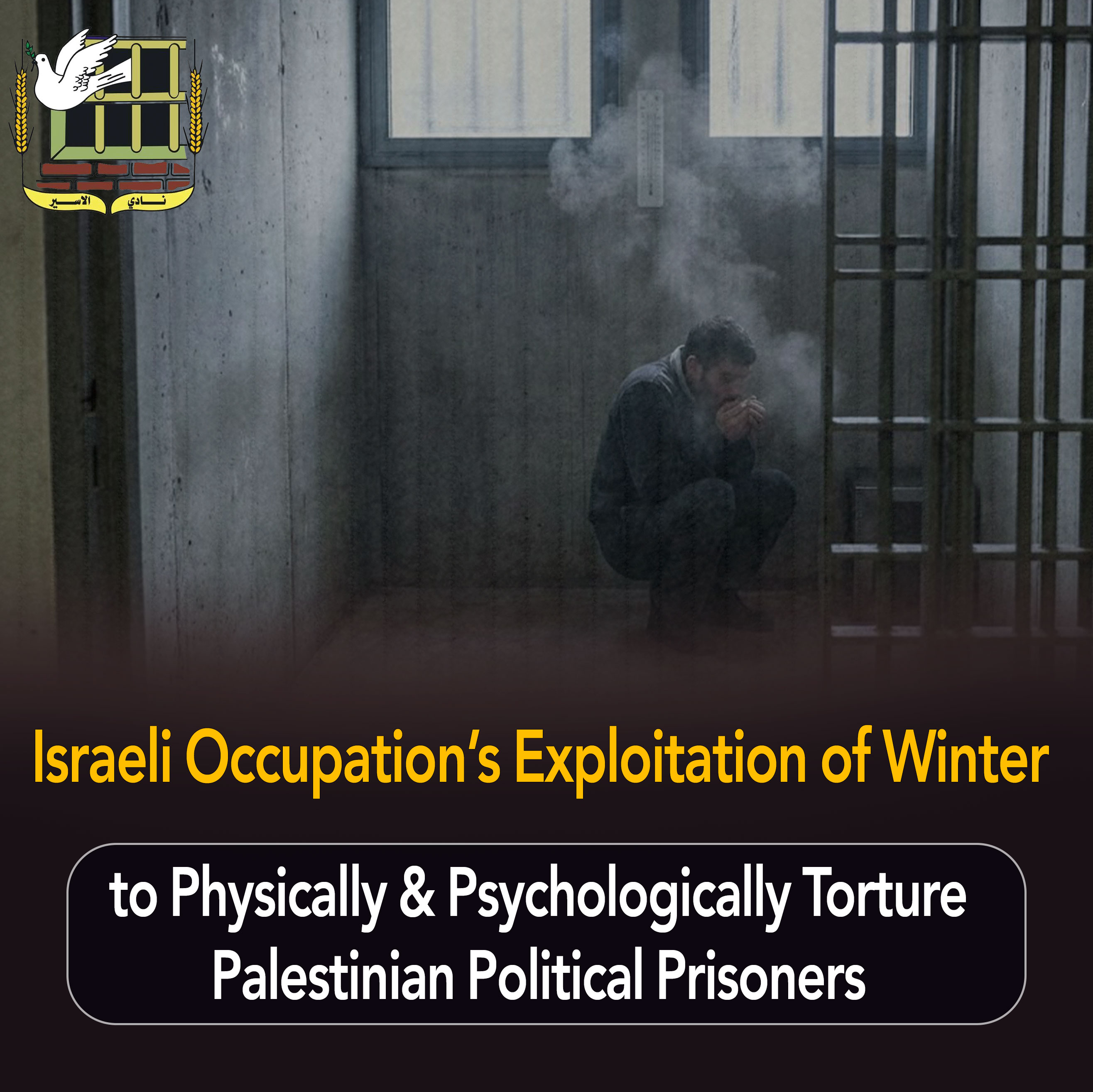
Israeli Occupation’s Exploitation of Winter to Physically & Psychologically Torture Palestinian Political Prisoners
Palestinian Prisoner’s Society (PPS)
January 22, 2026
Ramallah, occupied Palestine - Since the Gaza genocide, the policy of depriving Palestinian political prisoners of their personal belongings—including clothing and the most basic life necessities—has constituted one of the first arbitrary measures adopted by the occupation’s prison system, as a tool of collective punishment and systematic revenge. Over time, these measures have evolved from acts of retaliation into entrenched methods of physical and psychological torture.
More than two years into the genocide and the comprehensive assault targeting prisoners—an assault that has effectively turned prisons into a parallel arena of extermination—the Israeli occupation’s prison system continues to employ a wide array of tools to subjugate and torture prisoners. Torture is no longer confined to its internationally recognized definitions; rather, the method used have become impossible to enumerate within a comprehensive apparatus of repression that has led to the killing of more than 100 Palestinian political prisoners. Occupation authorities have revealed the identities of 87 people out of at least 100. Dozens of other martyred prisoners continue to be subjected to the crime of enforced disappearance.
The ongoing policy of deprivation of basic necessities—foremost among them clothing—stands as one of the most prominent manifestations of this torture, particularly with the onset of winter and the drop in temperatures. This has led to an acute escalation in the suffering of prisoners, including children and women. As a result, prisoners have contracted multiple illnesses due to the lack of adequate clothing, the absence of heating, and their confinement in overcrowded cells that fail to meet even the minimum humanitarian standards. Cells designed to hold six prisoners now confine between 10 and 12 people, forcing half of them to sleep on the floor. This is compounded by the poor quality of the blankets provided—extremely thin, ineffective against the cold, and often emitting foul odors.
Based on hundreds of testimonies and affidavits gathered by prisoners institutions, detainees have described winter in prisons as one of the harshest periods, particularly in the current phase of genocide, with the renewed spread of scabies as a direct consequence of the lack of hygiene, extreme overcrowding, and high humidity saturating cell walls, clothing, and blankets. The prison system deliberately imposes measures that contribute to the continued spread and expansion of the disease. Despite claims by the prison administration that treatment and winter clothing are provided, what is offered is merely symbolic: a single tube of ointment is insufficient even for one prisoner, yet detainees are forced to share it among all infected prisoners in a cell. The clothing provided is often second-hand and has itself contributed to renewed outbreaks of infection.
Added to this is the ongoing crime of starvation and the denial of food which could otherwise provide prisoners with a degree of energy, warmth and immunity during cold weather. Some military camp administrations deliberately keep cell windows open during winter and close them during summer. Under these cumulative conditions, the vast majority of prisoners suffer from extreme exhaustion and fatigue, including due to their inability to sleep amid the severe cold.
All of this is accompanied by severe repression carried out by heavily armed special units tasked with violently assaulting prisoners, terrorizing them psychologically, and using police dogs, gas, stun weapons against them.
Numerous legal teams have confirmed that prisoners are forced to attend visits under degrading and humiliating conditions, shivering from the intense cold—particularly in prisons located in desert areas, such as the Naqab and Ganot prisons, and in several military camps, foremost among them the Sde Teiman camp.
The Palestinian Prisoner’s Society affirms that the occupation’s prison system has transformed winter into a systematic tool of torture and a means of generating disease and weakening bodies, targeting prisoners and detainees, including children. Although these policies are not new and have been practiced for decades, the current phase is incomparable to any previous period in terms of the level of organized brutality imposed on prisoners in the aftermath of the genocide.
The PPS further confirms that attempts by several human rights organizations operating within the 1948-occupied territories to petition the occupation’s Supreme Court, seeking to compel the prison system to improve detention conditions, have thus far failed to achieve any tangible breakthrough. On the contrary, the prison system has deepened its crimes and entrenched its repressive policies, in blatant disregard of the limited recommendations issued by the Court—which has directly or indirectly colluded through silence and procrastination. This includes recommendations related to the provision of food, clothing, and treatment for scabies patients, despite the escalating reports issued by multiple bodies, including institutions affiliated with the occupation itself, confirming the unprecedented level of violations and crimes committed against prisoners.
As of January 2026, the number of Palestinian political prisoners exceeds 9,350 individuals acknowledged by the occupation’s prison administration, while many others remain held in army camps, with no precise data available regarding their numbers.