
Briefing on Findings Documented During Visits to Israeli Occupation Prisons in August and Early September 2026
9/9/2026
Palestinian Prisoner’s Society
Briefing on Findings Documented During Visits to Israeli Occupation Prisons in August and Early September 2026
Imprisoned Palestinian Women Made into Political Spectacle Amid Systematic Repression
September 9, 2026
Ramallah, occupied Palestine — The Palestinian Prisoner’s Society (PPS) carried out dozens of visits to a number of central prisons to Palestinian political prisoners throughout the month of August and the beginning of September 2026. The PPS presents this report summarizing prison conditions and the experience of detainees as part of its ongoing documentation, follow-up, and defense of Palestinian political prisoners.
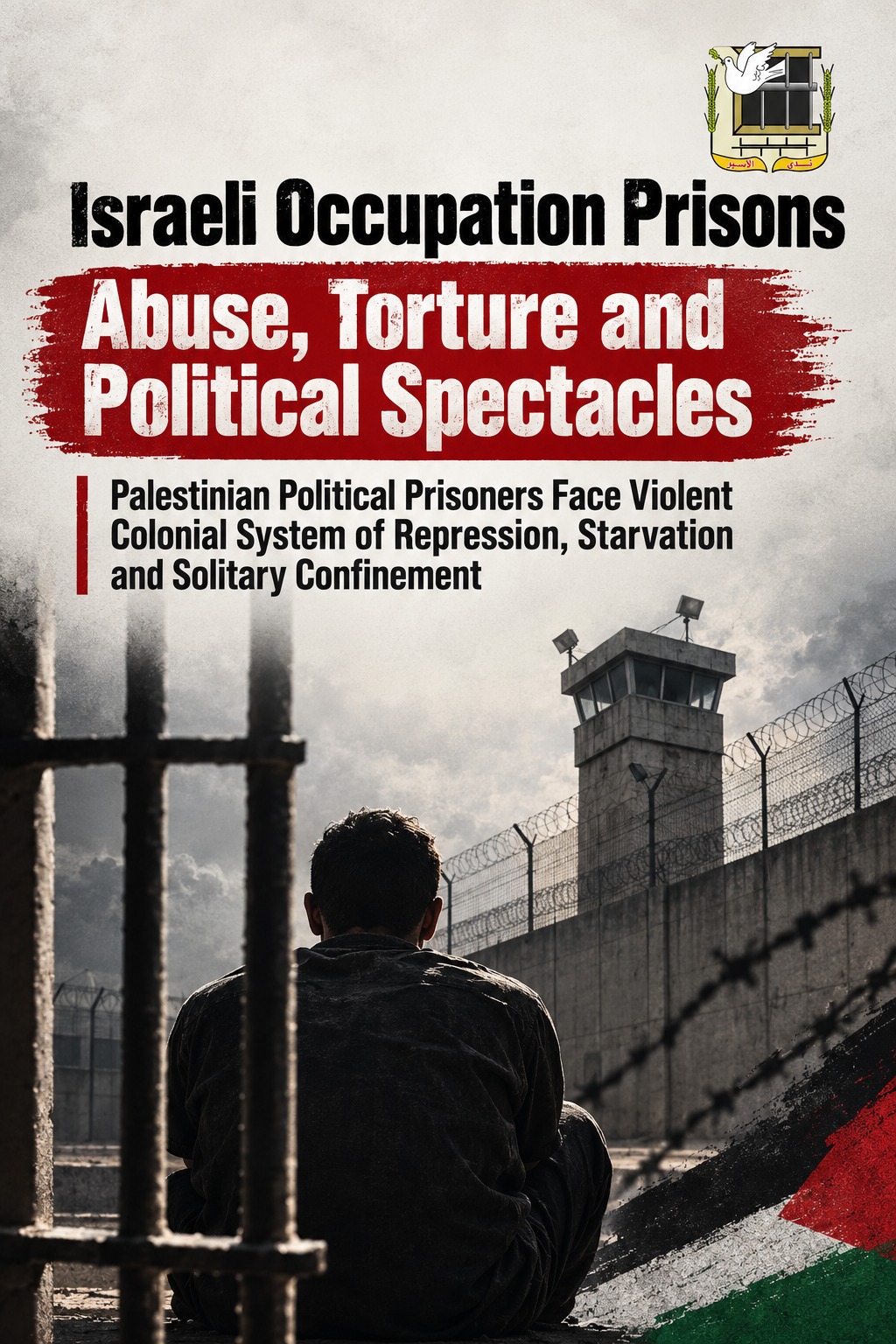
Israel’s prison system continues to entrench its policy of torture, abuse, and collective punishment against Palestinian political prisoners, as part of a broader set of systematic policies targeting their bodies, lives, and physical and psychological health. What the most recent visits have revealed does not point to isolated violations or individual misconduct—as we emphasize in our assessment of all the policies and crimes being perpetrated today—but rather to an integrated carceral structure in which tools of repression and humiliation, starvation, isolation, and denial of medical treatment have become established means of control, subjugation, and destruction.
The levels of escalation within this system vary according to a range of political and “security” developments, but the core of the policy remains unchanged: intensifying harsh conditions of detention, stripping prisoners of their basic rights, and turning the prison into a hidden space for the systematic use of violence, beyond effective international oversight.
As the Israeli elections approach, and as has happened repeatedly, the issue of Palestinian political prisoners becomes a battleground for political one-upmanship among Israeli parties and political figures, with prisoners’ bodies and suffering being exploited as a tool for demonstrating competition over ever-greater levels of extremism and repression. In this context, the prison ceases to be merely a place where detention is carried out and instead becomes a a stage for political spectacle, where Palestinian suffering is used to produce an internal political image of strength, brutality, and the ability to inflict abuse.
The Prison as a Stage for Political Spectacle: Ben-Gvir and His Family’s Raid of Female Prison
In this context, the visit by the fascist Israeli minister, Itamar Ben-Gvir, to the women prisoners’ section takes on a significance that goes beyond the raid itself, constituting a stark example of turning the prison and the female prisoners into material for political spectacle and propaganda, and of exploiting the violence inflicted upon them in the service of a political discourse based on incitement and extremism.
Ben-Gvir stormed the female prisoners’ section along with members of his family, raided two cells, personally documented the raid, and published a video in which he threatened the female prisoners.
This violation reveals an unprecedented degree of treating the prison as a space open to political spectacle, as well as a direct intertwining of political authority with the mechanisms of repression inside detention facilities. The presence of an Israeli minister accompanied by his family inside the women prisoners’ section, and his documenting and publishing of the scene, transforms the female prisoners from rights-bearing individuals detained under the authority of the occupation, into props in a political and propagandistic spectacle, making humiliation itself a deliberate act of spectacle.
More seriously, the visit took place in a context in which the female prisoners were already being subjected to repeated raids and acts of repression, making it part of a broader climate in which threats, punishments, isolation, and raids are used to reinforce a sense of insecurity and deprive the female prisoners of any sense of privacy or protection.
According to testimonies from the female prisoners, the visit was followed by a period of dangerous escalation in acts of mistreatment and repression. The female prisoners were barred from leaving their cells for three days with no shower or any of their personal belongings.
One of the female prisoners stated during her lawyer’s visit:
“During the latest repression operations, our hands are tied behind our backs and our eyes are blindfolded. We are then forcibly taken out with our heads bowed and made to lie on the floor. This is accompanied by shouting, insults, and obscene language. We live in a state of constant anxiety and heightened alertness, afraid of any sudden raid on the rooms. During every repression operation, the same forms of mistreatment are repeated, along with the repeated use of solitary confinement against the female prisoners and their detention in extremely harsh and degrading conditions, in addition to the deliberate filming of the repression operations.”
This testimony confirms that filming is not a marginal detail in the repression operations; rather, it constitutes an additional tool of humiliation and control in its own right. It transforms the moment of violence experienced by the female prisoners into material that can be documented and used outside the prison, constituting a further violation of their human dignity.
Female Political Detainees in Damon Prison: Repression, Isolation, and Humiliation as Policy
The issue of Palestinian female prisoners has never witnessed conditions of such severity and abuse as those taking place today. Since the start of 2026, female prisoners have been subjected to dozens of repression operations and raids, accompanied by various forms of assault, humiliation, isolation, and collective punishment.
During these repression operations, the female prisoners’ hands are tied behind their backs and their eyes are blindfolded, after which they are violently dragged to the prison yards. Their personal belongings are confiscated, including essential items on which they depend in their daily lives inside the detention facility. The repression forces have also intensified their use of tear gas, alongside imposing solitary confinement on a number of female prisoners.
The danger of these practices is not limited to the direct physical harm they cause. It extends to turning fear, apprehension, and humiliation into a daily condition experienced by the female prisoners, so that sudden raids, punishment, and solitary confinement become part of the management of their lives inside the prison.
Among the most prominent current cases is that of female prisoner Bushra al-Taweel, who was placed in solitary confinement and transferred to Ramleh Prison following a period of solitary confinement at Damon Prison, during which she was subjected to systematic repression operations.
We also highlight the case of female prisoner Shaimaa Khazem from Jenin, who is being held under administrative detention – without trial or charge - and suffered severe shock after receiving the news that her father had been assassinated in front of her younger brother. During a visit, she revealed that she had been subjected to a series of violations and punitive measures following her father’s killing.
Spread of Scabies in Prisons as a Central Tool of Torture
During these visits, the spread of scabies emerged as one of the most serious health issues currently facing prisoners, not only because of the extent of the infection, but also because it reveals the nature of the conditions in which prisoners are being detained.
The spread of the disease under these circumstances cannot be separated from methods of physical and psychological torture. The deprivation of hygiene, the shortage of hygiene supplies, overcrowding, poor ventilation, and the deteriorating detention environment, together with delays in providing necessary treatment and medical care, have turned the disease into an established reality—one that cannot be brought under control without eliminating the factors that cause it.
Thus, illness inside the prison has become a tool of torture: prisoners are left to endure their symptoms and pain for prolonged periods, while the conditions that facilitate the transmission and spread of infection continue. Accordingly, responsibility is not limited to the failure to provide treatment, but also extends to the continued existence of a detention environment that creates the conditions for the disease to spread and worsen.
In Ofer Prison in particular, prisoners’ testimonies focused on the widespread prevalence of scabies among detainees and the accompanying deprivation of necessary treatment and medical care. Prisoners reported that measures occasionally taken by the prison administration, which are presented as responses to health-related demands, remain limited and largely superficial. They do not address the causes of the disease’s spread or provide effective treatment to those infected.
One of the prisoners visited recently reported that he has been suffering from scabies for approximately four months, and that boils and inflammations have spread across his body, without him being provided with appropriate treatment. He also indicated that the overwhelming majority of prisoners suffer either from scabies or from symptoms and skin diseases associated with the catastrophic health and environmental conditions inside the prison.
This is accompanied by the continuation of repression and assaults, including the use of police dogs, sound and gas grenades, the firing of rubber bullets, and severe physical beatings. This makes the disease part of a broader reality of detention that combines physical harm with the deprivation of medical treatment.
Testimonies indicate that since the start of 2026, Ofer Prison has witnessed one of the most intensive campaigns of repression and abuse against prisoners, as part of an ongoing policy based on raids, collective assaults, and punishments. These practices add to the system of daily violations to which prisoners are subjected.
Scabies Reaches Female Prisons
In the same context, the Palestinian Prisoner’s Society has been following the issue of the spread of skin diseases among female prisoners in Damon Prison, including cases of scabies, alongside the spread of allergies and other skin conditions as a result of the harsh environmental and detention conditions, high humidity levels, inadequate ventilation, deprivation of personal hygiene supplies, and the failure to provide sufficient clothing, in addition to overcrowding inside rooms and cells.
These conditions constitute the same environment that has contributed to the spread of scabies in a number of prisons, amid the prison administration’s continued handling of the health situation of male and female prisoners through a policy of neglect and procrastination, rather than taking serious and effective measures to ensure treatment and prevent the disease from spreading.
Beatings, Starvation, and Repression: A Single System for Destroying Prisoners Psychologically and Physically
As for the visits conducted to the Naqab “Ketziot” Prison, the testimonies reflected the continuation of the same detention conditions. A number of prisoners emphasized the continued use of batons to assault them, along with the firing of rubber bullets, as well as systematic starvation that has exhausted the prisoners and weakened them physically and psychologically.
This reality was not confined to a single prison. It was also reflected in the majority of visits conducted to Janot, Gilboa, Ramleh, and Megiddo prisons, where the prison system continues to use starvation, physical assaults, humiliation, and deprivation as entrenched tools for managing prisoners’ lives and controlling every aspect of their existence inside detention facilities.
In Janot Prison, for example, the institutions continue to face persistent delays in scheduling visits. In addition, the visitation process in a number of prisons is accompanied by further punitive measures, including forcing the prisoner to proceed to the visitation room while shackled. In some cases, prisoners are forced to remain shackled even during the visit. This directly affects their ability to communicate their testimonies and limits the possibility of following up on their cases and documenting the violations to which they are subjected.
Child Detainees as Part of the System of Genocide in Prisons
The crimes committed against child prisoners are no less serious than those inflicted upon adult prisoners. The occupation continues to subject children to harsh detention conditions, within a system that deliberately uses repression, abuse, and the deprivation of healthcare as tools of punishment, harm, and psychological and physical destruction. This system does not stop at violating children’s rights inside prison; it extends to targeting their bodies and health, while depriving them of the most basic forms of protection and care that should be guaranteed to them as children.
The case of the child prisoner Mohammad Hamid exemplifies one of the most egregious manifestations of this crime. The occupation not only deprived him of his childhood and freedom, but also deprived him of his right to medical treatment after he contracted scabies in Ofer Prison, allowing his health condition to deteriorate dangerously.
This eventually led to complications affecting vital organs of his body, culminating in the amputation of one of his feet and requiring him to undergo a series of surgical procedures. Mohammad remains at the Shaare Zedek Medical Center in occupied Jerusalem in serious condition. His case clearly demonstrates that the denial of medical treatment within the prison system is not merely an isolated act of neglect, but rather a practice that can result in irreversible physical harm or even the death of a prisoner.
Continuing Rise in Number of Prisoners Suffering from Chronic Illnesses
The Palestinian Prisoner’s Society has also recorded a rise in the number of prisoners suffering from health problems and chronic illnesses, particularly prisoners whom the occupation has continued to detain for many years, some of whom have been imprisoned since before the genocide and remain in detention to this day.
Here, we highlight the case of elderly prisoner Muwafaq Arrouq, from the 1948-occupied territories, who is considered the oldest of the prisoners serving lengthy sentences. He has faced a serious health condition for years. Following the genocide, he was subjected to the same conditions experienced by prisoners generally, and today he is considered one of the most serious medical cases in the prison system.
Concerns are growing over the fate of elderly and sick prisoners, as well as prisoners held in isolation in Megiddo and Janot prisons.
Continued Solitary Confinement of Dozens of Imprisoned Political Leaders
At this stage, particular attention is drawn to the systematic targeting of Palestinian political leaders held behind bars, whose isolation and solitary confinement has become a deliberate policy that goes beyond its evident purpose. The policy of solitary confinement is being used to undermine the leadership structure and their role in representing prisoners as a whole, organizing their lives inside prisons, and defending their rights. Since the beginning of the genocide in the occupied Gaza Strip, the occupation’s prison administration has intensified the use of solitary confinement against dozens of political leaders, repeatedly transferring them between prisons, and cutting off their communication with other prisoners and with the outside world, in an attempt to undermine their collective means of confronting the prison system, dismantle any capacity for organization, demands, and protest, and turn them into isolated targets that are easier to exhaust and control.
The targeting of these leaders comes within the context of a broader policy aimed at breaking the prisoners’ movement from its structural level by targeting those who have historically played a role in representing prisoners, confronting prison policies, and resisting violations. Therefore, their isolation cannot be understood as a separate “security” or “administrative” measure, but rather as a punitive and political tool aimed at their role, status, and influence, seeking to impose a reality inside prisons based on fragmentation, isolation, and the elimination of any form of collective representation.
This is accompanied by severe beatings, humiliation, starvation, and deprivation of medical care and basic necessities, making the targeting of the leadership part of an integrated system aimed at destroying the individual, the prisoner, and their role, and seeking to weaken the prisoners’ movement and dismantle its ability to protect prisoners and defend their rights.
Accordingly, what the leaders of the prisoners’ movement are being subjected to does not represent merely a tightening of detention measures. Rather, it constitutes the systematic targeting of collective leadership within the prisons, as part of a policy seeking to forcibly reshape the reality of prisoners, strip them of their collective means, impose isolation upon them, and ultimately transform the prison into a closed space controlled by a system of repression without effective oversight or accountability.
The Barring of Visits by the International Committee of the Red Cross (ICRC)
Amid growing discussion about the possibility of resuming visits by the International Committee of the Red Cross (ICRC) to Palestinian prisoners, the Palestinian Prisoner’s Society emphasizes that, to date, there has been no actual or serious development on which this matter can be built upon. What has been circulating in the Israeli media regarding this issue does not, thus far, reflect any tangible reality on the ground, as Palestinian prisoners continue to be denied regular visits by the ICRC.
Despite the ongoing efforts and attempts made by prisoners’ institutions to pressure various parties and relevant actors at the international level to push for the urgent and effective resumption of ICRC visits to prisoners, the continued absence of an independent international mechanism capable of gaining regular access to detention facilities exacerbates the isolation experienced by prisoners and provides the prison system with additional space to continue its crimes away from effective international oversight.
The continued denial of prisoners’ regular access to the outside world, the obstruction of legal and human rights visits, and the absence of direct international monitoring also constitute key factors allowing torture, abuse, starvation, and medical neglect to continue inside prisons.
What has been revealed through visits and testimonies emerging from inside the prisons confirms, once again, that Palestinian prisoners are confronting a detention system based on torture, starvation, humiliation, deprivation of medical treatment, isolation, and ongoing repression. The crimes committed against them are no longer exceptional incidents or practices associated with temporary circumstances; rather, they have become part of an established and systematic policy targeting Palestinians inside prisons and continuously working to exhaust them physically and psychologically and push them toward slow death or long-term destruction, within the context of the ongoing genocidal approach.
The raid by Ben-Gvir and his family of the female prisoners’ section, and the filming and publication of that raid, encapsulates one aspect of the nature of this system: political authority entering the prison not to stop violations, but to exploit the presence and suffering of male and female prisoners for spectacle and incitement and to reinforce a discourse of power and violence. This incident reveals the extent to which violating prisoners’ dignity has itself become part of political practice, rather than merely a consequence of it.
What is happening to prisoners is a direct extension of the crime of genocide and part of an integrated system of torture, starvation, denial of medical treatment, isolation, humiliation, and repression. Meanwhile, international paralysis and silence expose a profound crisis within the international human rights system, which has failed to provide protection for victims. Its continued inaction has become a factor enabling the crimes to persist and those responsible to evade accountability.
Accordingly, the Palestinian Prisoner’s Society calls for urgent and effective international intervention; guarantees of immediate and regular access by the ICRC and human rights organizations to prisoners; an end to torture, starvation, denial of medical treatment, and isolation; accountability for those responsible for these crimes; and an end to impunity.
It is no longer acceptable for these crimes to continue in full view of the world while the international system limits itself to documentation and condemnation, leaving victims to their fate within a system of incarceration in which human dignity itself has become a target of punishment and prisons have become another arena of the ongoing genocide.
(ends)