
Approximately 350 Children in Occupation Prisons; Impunity Turns International System’s Failure into Silent Complicity in the Crime
November 21, 2026
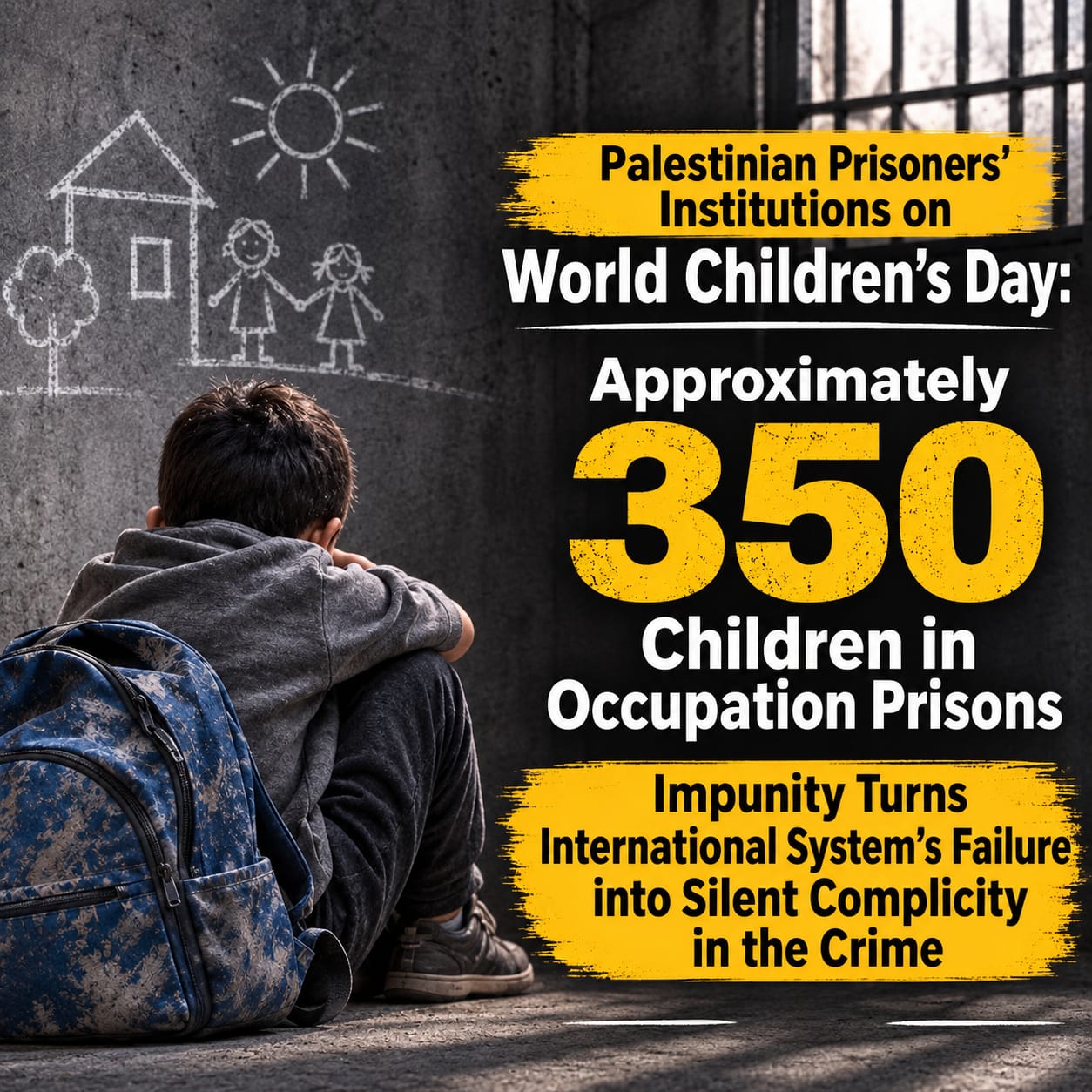
Palestinian Prisoners’ Institutions on World Children’s Day:
Approximately 350 Children in Occupation Prisons; Impunity Turns International System’s Failure into Silent Complicity in the Crime
· More than 2,000 cases of child arrests in the West Bank, including Jerusalem, since the start of the Gaza genocide; dozens of children from Gaza Strip subjected to enforced disappearance.
· Approximately 350 Palestinian children currently held in occupation prisons, including three girls; Dozens held in “administrative detention” without trial or charge.
· The child Walid Ahmad died of starvation in Megiddo Prison. The investigation was closed without anyone being held accountable, and his body was handed over frozen after being held for more than a year.
November 21, 2026
Ramallah, occupied Palestine – The genocidal Israeli occupation authorities are systematically inflicting severe physical and psychological damage to Palestinian child prisoners, the Commission of Detainees’ Affairs and the Palestinian Prisoner’s Society (PPS) said in a briefing marking World Children’s Day, observed annually on November 20.
The organizations said that the actions of the occupation authorities since the beginning of the crime of genocide in the Gaza Strip and beyond, represent an unprecedented turning point, from violations to the systematic targeting of Palestinian childhood. For decades, Palestinian children have been among the groups most vulnerable to violations, including killing, injury, deprivation of education, nighttime raids, and arrests affecting tens of thousands of minors. However, the genocide has made the issue of child prisoners a direct extension of the genocide itself. The child killed in an airstrike and the child starved in a prison cell are two faces of the same system; one that does not recognize Palestinian children as children.
Figures Reveal the Scale of Persecution of Children
Since the start of the genocide, prisoners’ institutions have documented more than 2,000 cases of arrests of Palestinian children by Israeli occupation forces in the West Bank, including Jerusalem. In addition, dozens of children from Gaza were abducted during the genocide and subjected to enforced disappearance and denied family visits, making it impossible to establish their exact number.
Today, approximately 350 children are held in occupation prisons, including three girls, under harsh and tragic conditions that violate their dignity and threaten their lives. These children were not arrested in isolated circumstances or through lawful procedures. Rather, they were abducted in military home raids, during confrontations, at checkpoints and in the streets, or even from schools and their surrounding areas. Added to this are extrajudicial executions targeting children during the genocide, as well as field interrogations targeting all segments of the population, including children.
From the Moment of Arrest: Treating the Child as a “Threat”
The crime begins in the early hours of the morning, with homes raided without warning, doors smashed, and soldiers shouting. Children are forced out of bed in their sleepwear and made to stand or sit on the floor for hours. Their phones and documents are confiscated, and they are informed of their arrest without being given a charge or explanation. Injured and sick children are often denied medication and medical care.
They are then shackled inside military jeeps, beaten and kicked while being transported over long distances. This marks the beginning of the first stage of enforced disappearance, during which their families are kept unaware of their whereabouts and physical condition.
During interrogation, sessions are conducted in an environment designed to break the child's will and extract a confession. This includes hours of continuous questioning without a lawyer or family member present, deprivation of sleep and rest, isolation, and psychological intimidation.
Thus, a procedure that is supposed to be governed by law becomes an instrument of systematic violations, leaving a profound impact on the child's life and future. This directly contradicts the protections guaranteed under the Convention on the Rights of the Child, including protection from torture and guarantees of a fair trial.
Daily “Life” in a Cell That Strips Away Childhood
Children live in overcrowded, poorly ventilated rooms, with inadequate clothing and worn-out blankets, and almost no freedom of movement. Their personal belongings are confiscated, and they are almost entirely deprived of family visits, communication with their families, and education. They also face repeated raids on their rooms and assaults carried out by special forces.
In this way, every fundamental aspect of childhood is taken away: family, education, play, and security.
Medical crimes against children have escalated since the beginning of the genocide. The denial of hygiene supplies and overcrowding have led to the widespread spread of skin diseases, particularly scabies. This is compounded by the denial or delay of medical treatment, the provision of painkillers unsuitable for their conditions, and the refusal to transfer children whose health is deteriorating to hospitals.
Starvation, meanwhile, has had a direct impact on their health and caused them to develop illnesses.
Walid Ahmad: The Child Who Starved to Death; Those Responsible Walk Free
The child Walid Khaled Ahmad, from the town of Silwad, starved to death in Megiddo Prison in March 2025. He was one of dozens of Palestinian prisoners and detainees who died following the genocide as a result of torture and starvation.
The autopsy report revealed severe wasting, a sunken abdomen, and a complete absence of muscle mass and subcutaneous fat in the upper body and limbs. It also documented air distension and extensive air collections extending to the pericardium, neck, chest wall, abdomen, and intestines, as well as a skin rash caused by scabies.
The report confirmed that starvation, including dehydration resulting from insufficient water intake and diarrhoea caused by colitis, were among the combined factors that led to his death.
The occupation authorities did not stop at killing him. They also closed the investigation pursued by his family through their lawyer, without holding anyone responsible or imposing any punishment. After holding his body for more than a year, the occupation authorities handed it over to his family in a frozen state and under harsh and tragic circumstances.
Thus, the crime extends from life into death, and from the child to his family.
Children in Gaza: Enforced Disappearance, Torture, and the Denial of Information
According to what the institutions have been able to document, arrest campaigns in Gaza have affected dozens of children. However, enforced disappearance and the denial of family visits have made it impossible to determine the exact number held in prisons and military camps.
The accounts given by released children are beyond what one can imagine. They describe systematic torture, the use of children as human shields during arrests, medical crimes, starvation, isolation, assaults, and raids and repression operations.
Some of these children were classified as “unlawful combatants,” under a law the occupation authorities have used against civilian detainees from Gaza. This has helped entrench torture practices that have led to the deaths of dozens of detainees.
The concealment of information in this context is not incidental; it is part of the crime itself. It hides victims and witnesses and keeps perpetrators beyond the reach of accountability.
“Administrative Detention”: Indefinite Imprisonment Without Charge or Trial
Following the genocide, the occupation authorities expanded their use of “administrative detention” against minors as a punitive and retaliatory measure, under the pretext of a “secret file” that children and their lawyers are not allowed to examine.
The number of children currently held in “administrative detention” is estimated to be in the dozens, representing the most dangerous precedent since this policy was first implemented.
These children are denied the right to defend themselves, while their detention orders are repeatedly renewed until their imprisonment becomes indefinite, with no foreseeable end.
This violates international standards, including the Convention on the Rights of the Child, which stipulates that detention must be used only as a last resort and for the shortest appropriate period. It also entrenches a systematic policy targeting the Palestinian generation amid the absence of effective international oversight.
Four Children Among Approximately 350: Examples of Their Peers Behind Bars
- Yaman Hossam Bani Odeh (born 14 February 2011, Tubas): He was arrested on 15 March 2026 by special forces and remains in “administrative detention” without trial or charge in Megiddo Prison. He is the brother of martyr Rayan Bani Odeh (17), who was killed on 25 December 2024. He therefore finds himself both a child prisoner and the brother of a martyr. His case is representative of dozens of children held in “administrative detention,” particularly those from areas where residents are in constant contact with occupation soldiers and settler attacks.
- Ola Qutaishat (born 27 August 2009, Tubas): A first-year secondary school student, she was arrested while sitting her examinations over what the occupation authorities allege was “incitement” on social media. She is being held in Damon Prison.
- Nada Odeh (born 27 November 2008, Tubas): A secondary school student who completed her first semester with excellent grades before being arrested on 12 February 2026 over what the occupation authorities allege was incitement. She is being held in Damon Prison.
- Rimas Dweikat (born 14 January 2010, Nablus): A secondary school student, she was arrested on 4 November 2026 over what the occupation authorities allege was “incitement.” When the authorities were unable to formulate an indictment against her, they transferred her to “administrative detention” for four months. She is being held in Damon Prison.
These cases reveal a harsh reality aimed at destroying Palestinian children, both psychologically and physically.
The institutions stressed that the treatment of child prisoners cannot be separated from the reality of impunity that the occupation authorities have enjoyed for decades. When an investigation into a child's death from starvation is closed without anyone being held accountable, and when crimes of torture and enforced disappearance continue without a single official being brought before a court, crime becomes a policy that can be repeated and expanded.
The absence of accountability does not merely protect perpetrators; it gives them the green light to commit further violations.
The institutions criticized the international human rights system, which, despite the abundance of conventions, mechanisms, and bodies, has remained unwilling to protect Palestinian children or to stop the violations committed against them.
Repeated statements expressing concern and condemnation have not translated into a single measure capable of changing the reality faced by prisoners. Family visits continue to be denied, and enforced disappearances continue, while independent bodies are prevented from accessing detainees.
Meanwhile, the principles established to protect childhood become mere words on paper when the child in question is Palestinian.
This double standard strips the international protection system of its substance, undermines people's confidence in it, and erodes the principle that international law applies equally to everyone.
The institutions renewed their call on the international community and organizations concerned with child protection to take concrete action that goes beyond statements of condemnation.
Such action must include:
· Compelling the occupation authorities to stop arresting children, end the use of administrative detention against them, and release all child prisoners.
· Ending the policy of impunity and holding those responsible accountable for crimes of torture, enforced disappearance, and starvation that have led to deaths.
· Undertaking a serious review of the performance of the international human rights system and its mechanisms.
· Transforming its principles and resolutions into binding and enforceable measures.
The institutions concluded by emphasizing that saving the children of Palestine is not solely a Palestinian issue; it is about safeguarding childhood throughout the world.
The standard by which Palestinian children are protected is the same standard by which every child must be protected. When the children of Palestine are left without protection or accountability, the childhood of every child, everywhere, is put at risk, and with it collapses the very principle upon which the international human rights system was founded.
**ENDS**